

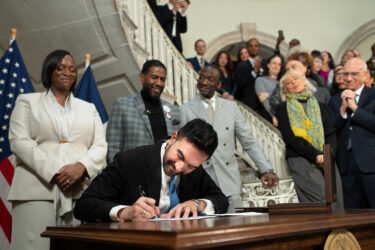
Mayor Mamdani signs executive order creating Office of Community Safety (photo: Michael Appleton/Mayor’s Office)
By Stephen Louis
On March 19, Mayor Zohran Mamdani signed Executive Order No. 15, establishing a new Office of Community Safety within the Mayor’s Office, and at the same time appointed Renita Francois as Deputy Mayor for Community Safety.
As previously described in CityLaw, there are a number of paths to move forward on Mayor Mamdani’s campaign pledge to establish a Department of Community Safety, which would create and expand mental health, crisis response, and violence prevention programs, taking a public health approach to safety. These policies would in many cases replace traditional police responses to mental health and public safety issues, giving the NYPD an opportunity to focus on its core anti-crime efforts.
The path chosen, for now, falls short of the ambitions laid out in Mayor Mamdani’s campaign. The Mayor has stated that his plan is to start with this Office and ultimately get to a more expansive Department, through negotiations with the City Council. But whether this is a stepping stone on the way to further action, or turns out to be the end of the road, some, and perhaps most, of the substantive proposals of the campaign can still be achieved through this mechanism.
First, a brief summary of what this seven-page executive order provides. It establishes an Office of Community Safety to be headed by a “Commissioner” who shall be appointed by the Mayor and report to the Deputy Mayor for Community Safety. As is the case with many “offices” located within the Mayor’s Office, its role will largely be to develop policies and strategies, described above, and to coordinate the actions of existing city agencies. One function will be to supervise five different offices already within the Mayor’s Office (all of which are established by the City Charter): the Office of Crime Victim Services, the Office for Neighborhood Safety and the Prevention of Gun Violence, the Office to End Domestic and Gender-Based Violence, the Office for the Prevention of Hate Crimes, and the Office of Community Mental Health.
In furtherance of its role as a coordinator of city agencies, it is authorized to collect information from relevant agencies, convene committees of those agencies, make recommendations to the Mayor about strengthening current community safety programs, coordinating mental health crisis response programs, and reviewing budget requests from city agencies related to community safety.
The executive order also resets the powers of the five offices listed above, which will now be under the authority of the Office of Community Safety. Finally, the executive order gives the new office contracting authority and directs agencies to cooperate with the office.
So what does this all add up to? How close does it come to the goals set forth in the Mamdani campaign? The answer: not yet clear.
Where does it fall short, or at least differ? First, and most obviously, it is not a new city “department.” Instead, it creates a new office within the Mayor’s Office. While the executive order refers to the head of that office as a “commissioner,” that person will not be a commissioner in the sense that term is used generally in city government – in other words, the person simply will not be in charge of a stand-alone agency. There is nothing wrong with using the term within the Mayor’s Office, although it seems slightly confusing, since heads of offices within the Mayor’s Office are typically called “directors.” It is somewhat akin to the Bloomberg Administration (and mayoralties thereafter) referring to the School District of the City of New York, previously referred to as the “Board of Education,” as the “Department of Education.” The state law changing many aspects of the school district, especially with regard to its leadership, did not change its name. For public relations purposes, the new name reinforced the idea that the school district was now under City control. Similarly, the term “commissioner,” while misleading, may reinforce the idea that while not a stand-alone agency, the new office may act in certain ways as an agency.
But will it actually act as an agency does, while within the Mayor’s Office? Its list of powers focuses on coordination of policies, not on actual operational implementation. While overall it is light on specifics, one item mentioned is the coordination of the Behavioral Health Emergency Assistance Response Division, known as B-HEARD — while making it clear that B-HEARD will still be run by the Health and Hospitals Corporation and the Fire Department. Presumably those carrying out the day-to-day functions of dealing with the issues outlined in the executive order will continue to be employees of the agencies. The office will make recommendations to the Mayor on agency policies, and presumably the Mayor and Deputy Mayor may direct agency commissioners to act on them, but while the office itself may monitor how those policy changes are carried out, it will not change policies by itself.
If this ends up being as far as the program goes, does it really fall that short of the promise? While a portion of the Mamdani campaign proposal was about structure, mostly it was about overall approach – focusing on new or expanded programs, especially those focused on preventing violence and other safety threats, and perhaps most noticeably reducing the role of police officers in dealing with the “frayed social safety net”, most notably with regard to responding to people in mental health crisis, people experiencing homelessness, and people dealing with substance abuse issues. That can be done by greater cooperation and coordination between the NYPD and social services agencies. While the NYPD is not specifically referenced in the executive order, it is implicitly one of the “agencies” directed to cooperate with the new office. So the order indeed sets forth a clear mission for the new office, which is meant to provide the coordination necessary to improve public safety. While it remains to be seen whether the new office and its to-be-named “commissioner” will be able to make the changes promised by the campaign, the tools are there at least to move forward.
*****
Stephen Louis is Distinguished Fellow and Counsel for the Center for New York City and State Law at New York Law School.