

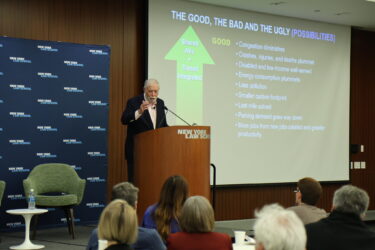
Sam Schwartz at New York Law School (photo: Michelle Phang/NYLS)
By Mark Chiusano
Driverless cars have seemed to be just around the corner in New York City for about a hundred years, ever since the American Wonder radio car coasted and crashed in Manhattan in 1925.
The level of imminence may be shifting, as robotaxis bloom in places like San Francisco and Phoenix, and Waymo continues testing in Manhattan and Brooklyn. Still, Governor Kathy Hochul’s proposal for allowing autonomous for-hire vehicles outside NYC was nixed amid budget negotiations this year, and prominent legislation to allow fully autonomous driving with no human backup remains in committee in the State Legislature.
“Based on where it stands, I expect it will require significant development before there is a clear path forward and [the legislation] is not anticipated to advance this session,” said bill sponsor Assemblymember Brian Cunningham, a Brooklyn Democrat, whose bill covers both for-hire and personal vehicles.
This suggests at least some time for policy-makers, industry leaders, drivers, and riders to prepare for an autonomous vehicle (AV) future, which was the subject of a public policy discussion at New York Law School on March 25.
The event featured Sam Schwartz, founder of the Transportation Research Program at Roosevelt House at Hunter College and a former New York City Traffic Commissioner; Sara Lind, co-executive director at Open Plans, a nonprofit focused on the city’s streets and public spaces; and Dinara Zhanpeissova, a for-hire vehicle driver and Independent Drivers Guild organizer. Schwartz, a longtime urban transportation researcher and consultant, gave an opening presentation on autonomous vehicles, then joined Lind and Zhanpeissova for a panel discussion. Here are three key takeaways, among many, from the event:
Inevitability and Benefits
New York has a reputation as a hard city to crack for driverless car companies, given its powerful taxi industry boasting close to 200,000 professional drivers across traditional cabs and for-hire vehicles and the complex density of its streets. Yet Schwartz, a longtime transportation expert, said of autonomous vehicles: there’s “no stopping them. They will be here.”
Schwartz outlined some of the technology’s potential benefits “if we do this right,” including fewer crashes, and less congestion “as long as the AVs are shared and integrated with transit,” with thoughtful regulations around vehicle-miles traveled.
Schwartz pointed to the ways these next-generation vehicles may be able to talk not just to each other, but to traffic signals and signposts. And he suggested that the tech could help solve the problem of commuting the “last mile” beyond the reach of subway stops, particularly in outlying suburban-style areas of the city.
Compounding Complexity
Still, pitfalls abound.
Lind pointed to the physical possibilities for robotaxis on the road. “They’re either going to continually drive around,” she predicted, “or they’re going to stop, and either double park and cause chaos, or they’re going to need a place on the curb.” That suggests a tradeoff between congestion and a reallocation of hard-fought curb space.
Schwartz echoed this concern with a parenthetical: if event parking turned out to be a steep $75, “you may tell that autonomous vehicle, go back home, and come back after the conference is over, and take me back” — adding another car on the road throughout those trips.
The panelists raised other hypothetical cascading impacts such as the health effects of less walking; the safety considerations of moving riders into cars and off the subways, an exceedingly safe mode of transit; the dearth of much independent data on AV safety; and even the potential for autonomous vehicles to be used “as weapons” by terrorists, noted Schwartz.
Waymo declined invitations to send a representative for the panel. But a spokesperson noted the company’s commitment to safety, including key aspects like steering and braking being isolated from outside communication. The spokesperson added that the company also strives to limit empty vehicle miles, including through public and private parking between rides, and has piloted credit programs to encourage rides to and from transit.
“We’re committed to working with the State Legislature to bring our service to New York, and help make the state’s roads safer,” the spokesperson said.
Waymo has been testing its technology across New York, including in Manhattan and Brooklyn, under legal authorization that ends April 1 but can be renewed.
The Future of Labor
While some of the pending AV legislation focuses on valuable licenses going to taxi medallion holders, there have been limited preparations for the livelihoods of many thousands of drivers likely to be impacted by the new technology.
That’s a mistake, said Zhanpeissova, noting that many Uber and Lyft workers in particular are immigrant breadwinners who rely on a job where they don’t have to speak English. Finding similar work without a language barrier is not so simple, she said. She called drivers like this “the real investor” who have already had to pay for their cars, insurance, gas, and more.
Zhanpeissova said education programs and incentives are needed for the transition, and raised the many aspects of for-hire driving work that go beyond taking someone from place to place. “These self-driving cars, they don’t open the car for you,” she said. In day-to-day driving, “You have to help, you have to carry.”
Lind echoed a concern about lost human connection in a city where robots are more prevalent, calling this “the kind of intangibles that we’re not thinking about as much as we should be.”
Schwartz said that if robotaxis replace Ubers and Lyfts in some cases, “we should aim for a living wage for drivers” — the ones that still have jobs. But he also gestured towards the possibility that New York could remain a holdout, or more of a holdout than other places, from full automation.
“New York may become like an amusement park where people still do things, you know, where we still have cars with drivers, where we still have taxis with drivers,” he said. “We might become a little island unto itself.”
WATCH THE FULL EVENT:
*****
Mark Chiusano is a journalist and senior fellow at New York Law School, and the author of the forthcoming book, Gigging Alone.