

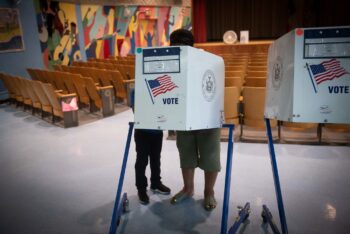
On the ballot (photo: Michael Appleton/Mayor’s Office)
By Stephen Louis
Mayor Zohran Mamdani’s charter revision commission, known as the Committee on Government Efficiency (COGE), has put forth proposals in five yes-or-no questions to appear on this fall’s general election ballot, available for all New York City voters to register their approval or disapproval. They deal with speeding up and simplifying processes for a variety of city projects and approvals, reducing paperwork for city contractors, and improving the City’s process to set aside a “rainy day fund” budget reserve.
COGE, a charter revision commission established under New York Municipal Home Rule Law section 36, had the flexibility to either ask the voters to approve one question that encompasses all the charter changes it is proposing or to break down the various changes into multiple questions.
The last time a New York City Charter Revision Commission proposed a significant overall revision of the Charter was in 1989, when the Board of Estimate was eliminated and its powers distributed to other bodies within City government. Since that time, charter revisions have tended to be “small-bore,” tackling fairly narrow, if sometimes significant, issues.
Typically, the components of each question are linked by topic or agency, and indeed COGE adopted that approach. And in setting forth five questions, COGE has, purposely or not, mimicked the actions of the last three charter revision commissions — those of 2019, 2024, and 2025 — which each placed five questions on the ballot.
Of course, COGE comes on the heels of DOGE, the Trump Administration’s “Department of Government Efficiency” initiative, led by Elon Musk, purportedly aimed at maximizing productivity in the federal government, but seemingly more interested in simply eliminating government programs and personnel. The notion of “efficiency,” at least as defined by DOGE, would seem at first glance contrary to the core message of the Mamdani Administration, which is based on a belief in an expansive government. However, government efficiency can be an important element of a progressive agenda.
First, to the extent government does not appear to be efficient, people can lose faith in it as a driver of solutions, and will want to reduce its role. Second, there are just so many dollars available to government, and the more efficient it is, the more it can accomplish within those resources. As Mayor Mamdani said, COGE was to “take a hard look at how City government functions and identify the reforms we need to deliver faster, smarter and more effectively for working people. Restoring faith in government starts with proving government can actually deliver.”
A common theme through most of COGE’s proposals is the belief that a lengthy process, with multiple notices, hearings, and decision-makers, at times combined with unnecessary paperwork on the part of applicants engaging with government, can result in delayed and weakened outcomes. Such complex processes can create burdensome expenses for both the government and the people and businesses with which it deals and opportunities for bureaucratic and legal delays. Several provisions related to outreach – including public hearings, published notifications, and timeframes that allow further consideration – and application filings would be reduced or outright eliminated if COGE’s proposals are approved by voters.
While many of the provisions potentially being amended have ensured that different perspectives are brought the table, and that as much information as available is presented for review, the judgment of the commission is clearly that any benefits of these requirements are overshadowed by their impact on results. For example, for years the procedures regarding outdoor dining – starting with sidewalk cafes and then expanding into other public spaces – has been remarkably complicated. These are the types of processes COGE focused on.
As COGE chair Patrick Gaspard said: “From simplifying construction permitting so we can rapidly tackle the housing crisis to making it easier to offer outdoor dining, we believe these proposals would help make our city more affordable and livable for working New Yorkers.”
In recent years the trend has certainly been that voters have approved the overwhelming majority of proposals coming out of charter revision commissions. As recently as last year, New York City voters approved a number of measures designed to streamline housing development reviews, despite a public campaign by the City Council to oppose them. Overall, COGE’s proposals do not appear to be very controversial and so far have not generated any notable opposition.
While COGE advanced a series of proposals aimed at greater government efficiency, it considered other measures it did not advance. One such possibility was the idea of new restrictions on the many reports that city agencies are required to publish and often go unread. [Read: After COGE: Further Consideration of City Government Reporting Requirements – CityLand.]
Below are brief summaries of the questions to be considered by New York City voters on their general election ballots, which will also include elections for statewide, state legislative, and congressional offices. For more detailed information, COGE’s final report is available here.
Question 1- Speeding up the process for revocable consent in public spaces
This question focuses on the use of public space for certain private purposes, in particular the creation of outdoor dining areas, but also lesser-known uses such as the placement of benches and planters on sidewalks.
The proposal would combine two separate approval processes into one, remove a newspaper notice requirement, and eliminate a step that allowed the City Council to weigh in, leaving the final decision to the Department of Transportation. This streamlining would reduce costs to applicants and presumably lead to an increase in the number of successful applications. This, along with other changes in city processes already adopted, comes out of the period during and after COVID, when sidewalk cafes and street dining became more popular and widespread.
Question 2 – Reducing city contractor paperwork and requiring meetings of the Procurement Policy Board
While contracting issues can often draw a big yawn from the electorate, the City’s failures in its contracting process, with respect to both signing contracts and paying contractors, has become notorious, despite many years of efforts to make improvements. This new proposal would simplify a number of processes that affect private companies and not-for-profits doing business with the City, for example by reducing the amount of information potential contractors have to provide on questionnaires. It would also require quarterly meetings by the Procurement Policy Board (PPB), a city body that regulates many aspects of City contracting but in fact meets infrequently and irregularly. COGE hopes that by meeting more often and on a regular basis, PPB would be more likely to respond to newly emerging challenges.
Of course, even if the PPB meets, there is no guarantee that it would take any particular helpful action, so it is not clear that this change would actually result in any action. Presumably, PPB members would be embarrassed if they did not act in some way at a mandated meeting.
Question 3 – Speeding up review of street safety projects, disposition of certain city property, and acquisition of office space
Again, here the focus is on simplifying and speeding up processes, in this case three: allowing the Department of Transportation to fast-track certain street projects; speeding up the process for city disposal of small properties and development rights; and speeding up the process for the city to lease office space. Most notably, the street project fast-tracking would allow DOT to start work on a project before presenting it to a community board, where DOT determines that there is a risk of significant injury that may occur absent immediate implementation.
To a somewhat more limited extent this seems to build on or be inspired by some of the changes proposed by the 2025 Charter Revision Commission, noted above, which reduced processes including those that included the City Council.
Question 4 – Simplify the building permit process and shift waterfront construction permits to the Buildings Department
Some ideas have been kicking around literally for decades before being acted on. Case in point – one part of question 4, which would change the oversight of construction of waterfront property from the Department of Small Business Services, which more generally has jurisdiction over waterfront property, to the Department of Buildings, which has greater expertise with respect to construction. This change could be made by a simple local law passed by the City Council, without a need for a referendum. However, somewhat mysteriously, while frequently proposed, it never happened.
The other significant potential change in this question is having the Department of Buildings create a centralized permitting hub for construction projects, so builders do not need to go from one agency to another to get all their needed permits. This appears to be modeled on an existing city program, initially developed during the Bloomberg Administration, that set up “one-stop shopping” for small businesses seeking certain permits. One additional small change is that the Commissioner of Buildings would be given more flexibility in setting up their deputy commissioner and senior staff structure, providing greater leeway in granting approvals.
Question 5 – Contribution targets for the Rainy Day Fund
While the City is authorized to create a “rainy day fund” to put money aside for budget emergencies, more formally known as a revenue stabilization fund, this proposal aims to help ensure that the fund is indeed created in a coherent and consistent manner. Twelve per cent of city tax revenues would be set as a target amount for the rainy day fund to hold each year, a deposit formula would be established, and withdrawals would be subject to new constraints. While not exactly an “efficiency” measure, this would help minimize the likelihood of the government running out of money in times of crisis – situations where unexpected expenditures or drops in revenue could wreck the budget.
*****
Stephen Louis is Distinguished Fellow and Counsel for the Center for New York City and State Law at New York Law School.
Editor’s Note: On October 20th, the Center for New York City and State Law at New York Law School is hosting an event to further discuss these ballot provisions. For more information and to register, click here.