

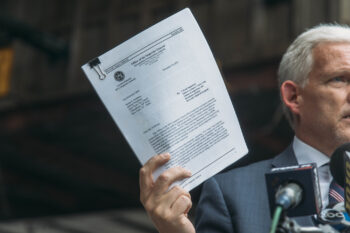
Reporting requirements in question (photo: Emil Cohen/New York City Council)
By Stephen Louis
On May 28, 2026, Mayor Zohran Mamdani announced the appointment of a charter revision commission that he called the Commission on Government Efficiency (“COGE”). He tasked its 15 commissioners and staff with reviewing the entire New York City Charter, but with particular emphasis on improving efficiency and modernizing government. As the Mayor put it: “New Yorkers deserve a government that works as hard as they do – and a government as careful with their money as they are…The Commission on Government Efficiency will take a hard look at how City government functions and identify the reforms we need to deliver faster, smarter and more effectively for working people.”
On July 2, after a set of initial public hearings, COGE published its Preliminary Staff Report. It included about a dozen ideas, mostly to accelerate or modernize city processes and requirements. Then, after further hearings, on July 23, COGE issued its final report, winnowing down these ideas to proposals captured in five distinct yes-or-no questions to appear on the fall general election ballot for voters to approve or disapprove. We will write about these questions in a follow-up article.
One topic that did not make the final cut for proposed reform but COGE says warrants further discussion has its roots in prior Charter Revision Commissions. There has been a longstanding concern, especially from city agency staff, about the number of agency reports and advisory councils mandated by local laws. These requirements were meant to provide elected officials and the public with needed information and the agencies with expert outside guidance but too often simply result in agency efforts that do little to advance any thoughtful agenda.
As city agencies are quick to point out, the more time and resources they must spend writing reports or engaging with advisory councils, the less time and resources they have to deliver services. Thus this topic directly relates to the efficiency goals of COGE and the mayor’s stated focus on improving service delivery. This is not the first time the issue of excessive reporting and advisory groups has come up. The 2005 Charter Revision Commission first considered the matter but did not advance any solutions. The 2010 Charter Revision Commission did create RABRC, although its solution has not been entirely satisfactory.
On June 23, I testified before COGE on this topic, alongside Jon Paul Lupo, formerly Director of City Legislative Affairs and Director of Intergovernmental Affairs during the de Blasio administration. We both urged changes in RABRC, to ensure that once unnecessary or duplicative reports and advisory boards are identified, the process results in their elimination. On July 13, Alex Camarda, Senior Policy Advisor for Reinvent Albany, also urged COGE to consider changes in the process to eliminate unnecessary reporting.
What follows is an edited version of my testimony.
As Legal Counsel Chief at the New York City Law Department, I participated in discussions regarding the 2010 Charter Revision Commission’s creation, as approved by voters, of the Report and Advisory Board Review Commission (RABRC), which was created to ensure that reporting requirements and advisory bodies would be reviewed on a regular basis to assess their continued usefulness. Subsequently, I was involved in the implementation of RABRC’s Charter-mandated process, as set forth in Charter section 1113.
There is no question that legally mandated reports and advisory commissions perform an important, even essential role in City government. Agencies should be held accountable, and reporting requirements can ensure that both those who oversee those agencies, and the public at large, have access to the data that drive those agencies’ actions and indicate success or failure. The Mayor’s Management Report is perhaps the best-known report required by local law – providing a great deal of performance-related data on a broad scope of services.
Agencies also can benefit from advisory commissions that look at issues from a different perspective and deliver alternative approaches for the provision of government services.
However, it is also clear that sometimes these reports and advisory commissions outlive their usefulness, at times because the report or commission is duplicative of other reports and commissions and sometimes because changed circumstances have altered the mandates of the targeted agencies so that the reports or commissions are no longer relevant to their mission. Agencies end up spending time and resources that could be better spent in other ways.
RABRC has served well in reviewing reports and advisory commissions and recommending their termination. And the City Council has often accepted those recommendations. One good example of a completely unnecessary reporting requirement that was ultimately eliminated was the annual report by the Business Integrity Commission regarding applications for shipboard gambling applications. As it turned out, when RABRC considered this report in 2023, the City had not received any applications for over 20 years and did not expect to do so in the near future. Here, the City Council accepted RABRC’s recommendation.
However, it appears the process has not fully yielded the desired results, and relatively few reports and commissions have actually been eliminated.
The Charter Revision Commission should consider approaches to either strengthen the RABRC process or change how reports and advisory commissions are created in the first place. These changes should not take away from the City Council its ultimate authority to mandate these reports and commissions, but might shift the process just enough to ensure that reports and commissions remain relevant and meaningful well after their original mandate.
Under the current scheme, once RABRC has recommended the elimination of a report or commission, the City Council has 120 days to confirm or reject RABRC’s findings. An alternative approach would be to make the RABRC determination final. The Council could, upon due consideration, pass a new local law reinstating the report or commission, but requiring a new local law might give the Council more of an opportunity to reconsider its original mandate, and/or modify it to be more relevant. One other alternative would be to continue the RABRC process as is, but require that any local law mandating a report or advisory commission have an automatic sunset period, perhaps five or ten years, thus ensuring that all reports get a new hard look at regular intervals.
Undoubtedly there are other approaches that could be taken to improve the current process.
In its final report, COGE urged that a future commission consider reforms in this area and suggested that the City Council include sunset dates in any new reporting requirements. Since COGE has decided not to move forward on changes to the process, it will be up to City Council to consider that suggestion, and to the Council and the Mamdani Administration to decide whether they can use the existing RABRC process to significantly reduce the number of unnecessary reports and advisory councils as originally contemplated or simply wait for another charter revision commission to raise the issue yet again.
*****
Stephen Louis is Distinguished Fellow and Counsel for the Center for New York City and State Law at New York Law School.