

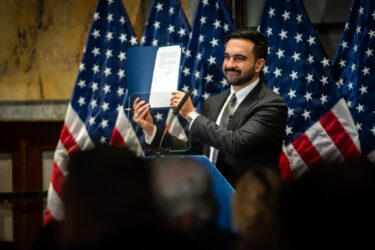
Mayor Mamdani signs executive order (photo: Ed Reed/Mayor’s Office)
By Stephen Louis
When Zohran Mamdani ran for Mayor, one of his leading proposals was the creation of a new Department of Community Safety. His campaign website includes a report setting forth the two main components of this initiative. One is creating a new city agency — the Department of Community Safety (DCS) — that would take a public health approach to safety. The other is a list of programs — some new, many existing and currently run by other city agencies or offices — that would be implemented by DCS to achieve its goals.
The campaign platform document, which remains the most thorough published outline of the initiative to date, does not discuss how DCS would come into being. It includes a basic organization chart showing different divisions and offices to be housed within the new department, typical for a city agency. For example, the Division of Victim Assistance and Community Repair, the Office of Gun Violence Prevention, and the Office for the Prevention of Hate Crimes.
The plan includes an estimated annual budget of about $1.1 billion, a combination of new funding (about $500 million) and funds transferred from existing agencies (about $600 million). It does not include an estimate of the number of DCS employees, nor does it state how other agencies would be impacted by the creation of this agency, other than a lessening of the role of the Police Department. Presumably certain functions of the Department of Social Services, the Department of Homeless Services, and the Department of Health and Mental Hygiene would be affected, either by being transferred to, or being coordinated by, DCS.
In mid-December and in anticipation of Mayor Mamdani soon taking office, City Council Member Lincoln Restler introduced a bill to create DCS by amendment to the City Charter. Then Mayor-elect Mamdani spoke favorably of it, describing it as “an important first step” but without clearly endorsing it. More recently, there have been reports that the Mayor intends to appoint a deputy mayor to oversee DCS. Still left unsaid is how the Mayor intends to create the Department of Community Safety.
Creating a new city agency does typically entail amending the City Charter and doing so through a local law. This is a not-uncommon occurrence as administrations consider better ways to deliver services. The City Council is often amenable to mayoral requests to reorganize operations, especially early in a Mayor’s term or when problems in city operations are apparent.
Such legislation need not be complicated. The basic structure of the agency is typically laid out, with some description of leadership, in particular the number of deputy commissioners, along with any experiential or educational background requirements for a commissioner. It would include the powers and duties of the agency and at times a general breakdown of different units within the agency. Sometimes the legislation will include repeals of powers and duties of other agencies, although that may not be necessary in this case, where interagency cooperation is contemplated.
A local law that creates a new agency will also include transitory provisions that contemplate the transfer of personnel, rule-making, and other ongoing matters from one agency to another. These provisions allow a smooth transfer of functions. Generally such legislation will include an effective date several months after enactment, to give the new agency a chance to organize.
In the new term, Council Member Restler re-introduced his bill (now Intro. 403) to create DCS. It has 28 sponsors (in the 51-seat Council). It adds a new chapter in the City Charter. It provides for a DCS commissioner but does not outline any deputy commissioners, nor does it lay out any particular units within the agency, other than requiring an office in each borough. It presumes that DCS would coordinate with other departments and explicitly states that the creation of DCS would not take any statutory powers of any other agency. It does not seem to contemplate any transfer of personnel from other agencies, or at least does not specifically provide for that. It would take effect 180 days after becoming law.
As noted, the bill as currently drafted does not include a number of provisions that might be expected in a bill creating a new agency. However, this is not unusual for an initial draft of a local law. This is the start of the legislative process, and if it moves forward, presumably will be amended with substantial additions. For example, a number of contracts with nonprofit organizations relating to gun violence prevention currently held by other agencies would be transferred to DCS via the type of transitory provisions referenced above. But the fate of Intro. 403 at this point is not clear. It has been referred to the Committee on Government Operations, State & Federal Legislation. A hearing on the bill has not yet been scheduled.
If the City Council does not move forward with the legislation, or the Mayor does not want to go that route to create DCS, what are the Mayor’s options?
One approach is to use City Charter section 11, which actually provides a path for reorganization of mayoral operational agencies, albeit one that has rarely, if ever, been successfully used with regard to major reorganizations.
It allows the mayor to use executive orders to transfer functions from one agency to another and to create new agencies. However, the reorganization plan must first be submitted to the City Council, which has 90 days to approve or disapprove the plan (if it does not act within 90 days it is deemed approved). While this appears to be a swift alternative, the power of the Council to disapprove a section 11 plan means the Mayor must not only convince the Council of the plan’s merits, just as with a local law, but of the need to use this mechanism when a local law could achieve the same goal. It seems unlikely that the City Council would cede its authority to create a new agency by allowing such a plan to go forward.
The other approach is to not create an actual stand-alone agency, but instead create a framework where existing agencies pursue a joint initiative to achieve an equivalent outcome. One such path would be to create by executive order an Office of Community Safety within the Mayor’s Office. There are a number of “offices” created by executive order. For example, the Mayor’s Office of Criminal Justice was originally created by executive order to coordinate and increase cooperation among criminal justice agencies. (It was eventually placed in the Charter, with increased responsibility.) The executive order could even describe this office as a “department” although it would not actually be a department, which by definition is a standalone agency.
That office would presumably operate under the deputy mayor that reportedly will be appointed. It would coordinate the activities of existing agencies to ensure that the policy initiatives outlined in the campaign plan be implemented. The executive order could also include provisions directing that the Office of Management and Budget (OMB) determine the additional resources necessary to fund the new office and implement coordination, and directing the relevant agencies to work with the deputy mayor and each other to achieve the stated goals.
Taking this approach would have its own challenges, as bureaucracies in place would have to adjust to new directions, and agency officials and outside partners would wonder whether the changes are temporary in nature. However, it could in theory accomplish most, if not all, of the goals of the campaign promise.
Finally, such an executive order could contemplate parallel tracks. The executive order could be written in contemplation of seeking the local law creating DCS as an agency. Policy changes could be initiated under current agency structures, and then, when DCS is created, continue and move forward. Indeed, one of the functions of the office could be to determine the best way to structure DCS as a separate agency and to draft the local law accordingly. The Mayor could thus take quick action and still look for the longer-term reorganization he has proposed.
*****
Stephen Louis is Distinguished Fellow and Counsel for the Center for New York City and State Law at New York Law School.