

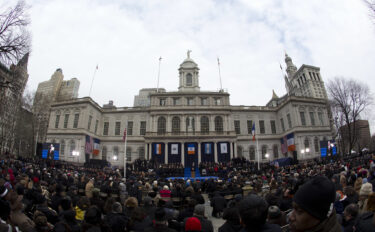
Inauguration Day 2014 (photo via Mayor’s Office).
By Stephen Louis
On January 1, 2026, Zohran Mamdani will become the Mayor of the City of New York. He will be busy from Day One. But to implement his policies, both big and small, what does he have to do on Day One, or shortly thereafter?
Oath of Office
New York State Constitution Article XIII, section one requires public officers, such as the Mayor, “before they enter on the duties of their respective offices” to take the oath of office as set forth in that provision. Public Officers Law section 10 provides further details regarding the oath. Both provisions make it clear that taking the oath is a prerequisite for exercising authority. Thus we will see the new Mayor take the oath at midnight to ensure that he immediately assumes authority as the term begins. A ceremonial oath-taking, accompanied by speeches, will take place later that day before a large audience.
While the oath requirement may seem to be a mere formality, it is not. Under Public Officers Law section 30, a public officer is considered to automatically vacate their position if they fail to take the oath within 30 days of the beginning of their term, so as a prerequisite to governing, the mayor certainly will take the oath as required.
Executive and Emergency Orders
The Mayor is authorized under section 8 of the City Charter to issue executive orders to establish the internal organization of the Mayor’s Office, and delegate many of his powers to Mayor’s Office staff. In addition, mayors often issue executive orders to establish advisory bodies to recommend policy initiatives, and to give general instructions to agencies on their operations.
Typically, on taking office a Mayor will immediately issue an executive order continuing all prior executive orders, ensuring that there is continuity regarding City operations. If, after fuller consideration, any of these prior executive orders prove inconsistent with a new mayor’s policies, they can simply be revoked or amended as necessary.
Another executive order that a Mayor can be expected to issue very soon upon taking office is one that sets out the powers and responsibilities of the deputy mayors and other senior staff. This ensures clear lines of authority with respect to their functions. This executive order will also include many delegations of authority – for example, to sign certain agreements – so the mayor does not need to personally engage in every matter that crosses their desk. The executive order would also include a broad delegation to one deputy mayor, typically the First Deputy Mayor, allowing the deputy to exercise all powers that may be delegated in case of the Mayor’s absence or inability to carry out their functions.
There is another noteworthy type of order, authorized by section 24 of the New York State Executive Law – the emergency order, in which the Mayor takes extraordinary action to deal with emergencies. In certain circumstances the emergency order can be used to suspend local laws. These emergency orders have to be renewed every five days to remain in effect. In some cases, emergency orders can last for years after the initial emergency because recovery can drag on, as was the case after Superstorm Sandy.
Currently, there are two emergency orders that are regularly renewed – one relating to asylum seekers and one about Rikers Island. Assuming Mayor Adams renews those emergency orders through the end of his administration, Mayor Mamdani will have at the most five days to make one of three choices: either renew or revoke those orders, or allow them to lapse upon expiration.
Budget
The Charter calls on a newly-elected Mayor to issue a preliminary budget by February 1 – just one month after taking office. That does not give the new Mayor much time to reframe the budget to reflect new priorities. Even if there is not enough time for the preliminary budget to reflect new priorities, the new Mayor will still have time to make changes in the executive budget, which will not be issued until Spring. Of course, much of the budget will not change, or only change incrementally, regardless of who is Mayor. Still, there will be some elements that will grow or shrink depending on the new Mayor’s initiatives.
State Legislation
The New York State Legislature’s annual session begins in early January and ends in June. Much of its work, along with the Governor’s, culminates in the passage of a state budget – either by the April 1 start of the new state fiscal year or shortly thereafter. The budget not only appropriates funding, it often includes substantive changes in law, some of which have additional fiscal implications – thus the window for action or influence by a new Mayor on important issues may be as little as three months. At the same time, the City of New York typically has a very long state agenda of legislation – authorization of new programs, amendment or repeal of onerous legal requirements, and the renewal of sunsetting laws. In addition, a new Mayor often adds top priorities to that list.
Much time is also spent on defense – convincing the State Legislature not to pass certain bills. In a typical year, the City starts to prepare its Albany agenda the prior fall, well before the next legislative session. But when the City is between two administrations, any agenda will be at best extremely tentative until the new Mayor takes over, unless internal discussions are held well before January.
Local Legislation
The City Council is scheduled to hold its final 2025 meeting on December 18, and presumably will pass a number of bills at that session. (Any bills introduced but not acted upon at that time must be reintroduced in January to be considered.) Since a mayor has 30 days to act on legislation, this means that some bills may not have been acted upon by Mayor Adams by the end of his term. Mayor Mamdani will then have a chance to consider these bills after taking office. The 30-day period does not start again when a new mayor takes office, so he will have a shortened time to act. However, before he takes office, he will know what those bills are, and will have time to consider his actions. If he does not object to certain bills, he may simply allow them to lapse into law, but if he has an objection he could veto, subject to potential City Council override.
Mayoral Appointments
Among the most consequential decisions to be made by a Mayor(-elect) is choosing the core members of the Mayor’s leadership team – both within the Mayor’s Office and at the most important city agencies and affiliated entities.
The decision-making process can begin well before Election Day, but accelerates after the results are in, and the selection process can expand beyond the Mayor-elect’s inner circle.
In most cases, the Mayor is free to appoint anyone to these positions, provided they meet the minimal requirements of section 3 of the New York State Public Officers Law: 18 years of age or older, a citizen of the United States, and a resident of New York City, and not have been convicted of a felony, nor been convicted of a misdemeanor within the previous five years.
These are the minimal requirements for commissioners, board members, and other agency heads. Whether they apply to Mayor’s Office staff has to be considered on a case by case basis. These requirements only apply to “public officers” – persons who exercise an element of “sovereign power.” There are members of the Mayor’s staff who have key roles in the Mayor’s inner circle but who do not exercise such power, and thus are not considered public officers. For example, typically a communications director would not be subject to these requirements.
Many positions have additional requirements, that basically fall into two categories – either approval by another body (typically the City Council) or experience. The relevant statutes applicable to each office have to be looked at to determine whether any “extra” requirements exist.
For example, the Corporation Counsel and the Commissioner of Investigation have to be approved by the City Council. The Commissioner of Health and Mental Hygiene must be a doctor of medicine and have either an educational or experiential background in public health. The Chancellor of the Department of Education must meet a combination of educational and experiential prerequisites or obtain a waiver of those requirements by the State Commissioner of Education. Beyond these minimum requirements is full-scale vetting, which generally involves lengthy questionnaires and deep dives by the City’s Department of Investigation.
It is not unusual for an administration to take several months to fill all its key members. Some commissioners of the current administration may be asked to stay on at least temporarily until replacements are found. If, for whatever reason, they do not continue into the new administration, there will typically be a deputy who can serve until there is a new appointment.
This is the first article in a series on steps by a new Mayor as the City approaches Inauguration Day on January 1, 2026. Next, we will further consider appointment issues, including the handling of “holdovers” and the possibility of removing certain persons from their positions “for cause.”
Stephen Louis is a Distinguished Fellow and Counsel for the Center for New York City and State Law at New York Law School.
*The same provision in Public Officers Law section 30 provides for vacature in case of failure to file any required “undertaking” or bond within 30 days of taking office. This came up shortly after the last inauguration when it was discovered that the new Comptroller, Brad Lander, had failed to file a bond as required in the City Charter within the required time frame. The State Legislature passed a law that gave the Comptroller an opportunity to fix the error and remain in office.