

Community group claimed landmarking would hinder responsible development plans. On January 16, 2007, Landmarks held a hearing on the Renaissance Ballroom and Casino, comprised of two buildings at Adam Clayton Jr. Boulevard and West 137th Street in Harlem. “The Rennie,” as it was known, was designed by architect Harry Creighton Ingalls and built in stages between 1920 and 1923. One of the first entertainment complexes in Harlem, and one of the largest African-American owned enterprises … <Read More>
Search Results for: Landmark District Designation
Hearing held on 1860 cast-iron building
Owner opposed, claiming that building was a “knock off” of famous cast-iron pioneer. Landmarks held a public hearing on the proposed designation of 63 Nassau Street, a cast-iron building in lower Manhattan that Landmarks’ research staff attributed to the pioneer of castiron construction, James Bogardis. The building, thought to be constructed in 1860, contains carved medallions of George Washington and Benjamin Franklin that are similar to those on the Bogardis building at 85 Leonard Street, … <Read More>
Testimony taken on three West Village buildings
Wide support voiced for landmarking of three 19th century Far West Village buildings. On November 14, 2006, Landmarks held hearings on the possible designations of 159 Charles Street, the Keller Hotel, and the Edwin B. Brooks House, all located in the Far West Village.
The merchant Henry Wyckoff built the Greek Revival row house at 159 Charles Street in 1838 on the site of the former Newgate Prison. Wyckoff built eight houses in the area, … <Read More>
Board of Estimate vote revisited 16 years later
Landmarks re-designates two City and Suburban Homes buildings carved out from 1990 designation. On November 21, 2006, Landmarks ended the controversial debate over the landmark status of the City and Suburban Homes Company’s First Avenue Estate in Lenox Hill by voting unanimously to amend its landmark status. In 1990, Landmarks unanimously designated all 15 buildings in the First Avenue Estate, a development constructed between 1898 and 1915 over the entire block bounded by East 64th … <Read More>
19th-century concrete building designated

- New York and Long Island Coignet Stone Company building in Gowanus, Brooklyn. Photo: LPC.
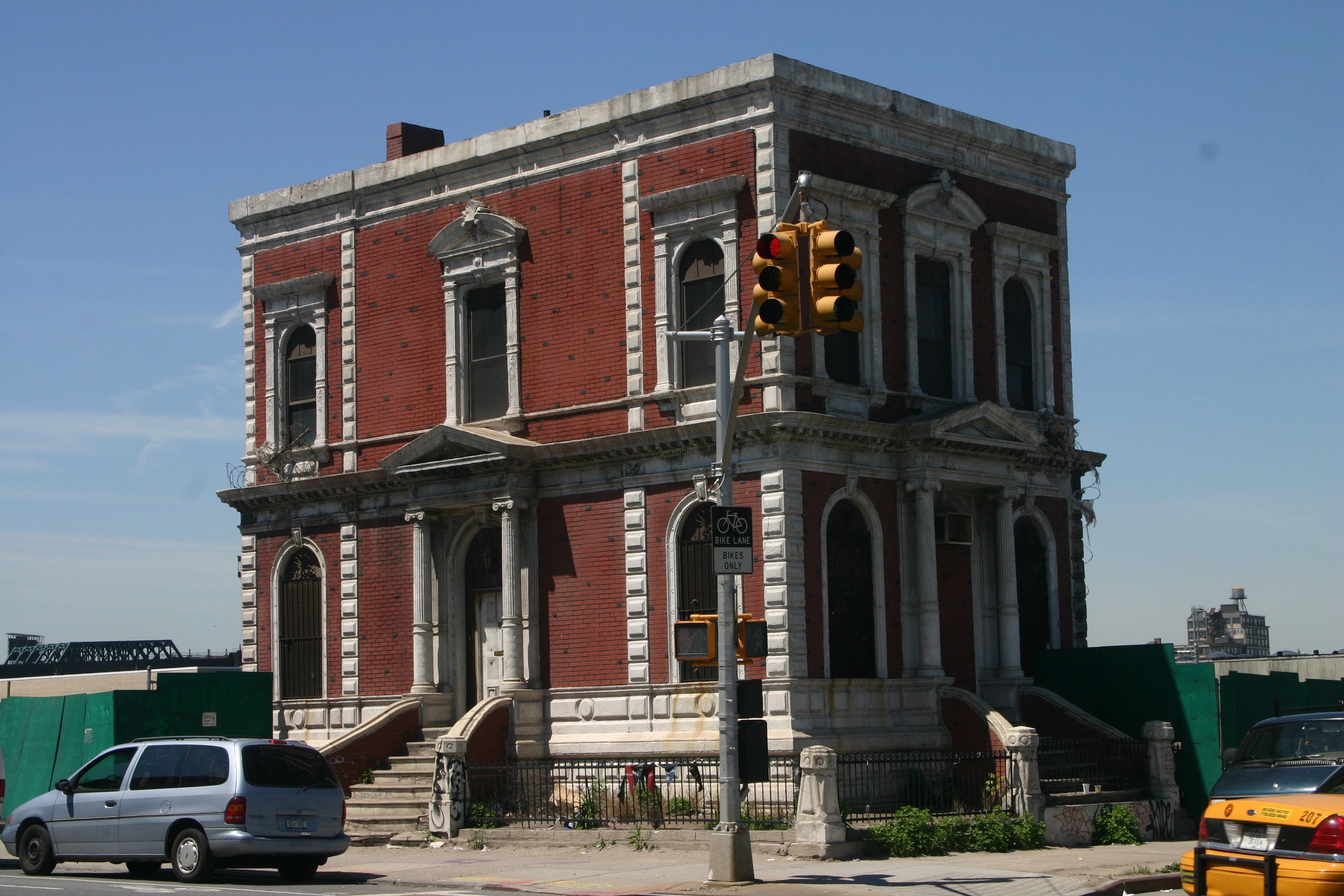
1872 Brooklyn building designated unanimously. Landmarks designated the New York and Long Island Coignet Stone Company Building at 360 Third Avenue in Brooklyn, the city’s earliest known concrete structure. Designed by William Field and Son, the 1872 building was meant to showcase the possibilities of concrete. Francois Coignet, the company’s founder, was an early proponent of concrete as an alternative to … <Read More>
Court orders LPC to reevaluate significance of house
Homeowners claimed house was wrongly described in Historic District report. In December 2004, the Landmarks Preservation Commission designated the Douglaston Hill Historic District in Queens. The Mosleys, who had purchased a home in the District in October 2004, sued Landmarks, seeking to do away with the Historic District altogether or alternatively, remove their home from the District. The Mosleys claimed that the designation of the District was arbitrary and capricious because the Commission had denied … <Read More>