

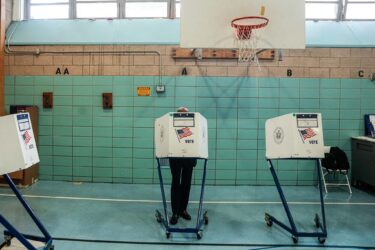
Image Credit: Michael Appleton/Mayoral Photography Office.
By Jarret Berg
In October, the New York State Court of Appeals unanimously upheld New York’s recently enacted Even Year Elections Law (EYEL) as constitutional, confirming that state lawmakers have the authority to move most local elections to even years via ordinary legislation, aligning them with higher-turnout elections when federal and state candidates appear on the ballot. While such a ruling by the State’s high court is intended to achieve finality, that hasn’t slowed down opponents of election consolidation, who are mobilizing to stymie the effort in various ways.
A new challenge to the law has been filed in federal court (in the Eastern District of New York) by the New York Republican Party, Nassau and Suffolk GOP, Nassau, Suffolk, and Orange Counties, various towns, and several local politicians. These Plaintiffs argue the Even Year Election Law violates the First and Fourteenth Amendments and Section 2 of the Voting Rights Act (VRA), and are counting on Federal Courts—including, perhaps the VRA-antipathetic Supreme Court majority—to do what New York’s highest court would not: block the change from taking effect or allow localities to opt out of even-year elections.
The 2023 legislation moved most town and county contests to even-numbered years, but it excluded races in cities and villages, and races for county clerk, sheriff, district attorney, local judges and others that have odd-year election dates entrenched in the state Constitution (e.g. N.Y. Const, Art. VI § 21; Art. XIII §§ 8 and 13(a)), so an aligned effort has been underway at both the New York City and State levels to synchronize the staggered elections for many remaining offices. That included ballot question six on this year’s New York City general election ballot, which asked voters in the five boroughs whether they support the proposal to “[m]ove the City’s primary and general election dates so that City elections are held in the same year as Federal Presidential elections, when permitted by state law.”
Voters in four out of five boroughs shot down the proposal by more than 100,000 votes total (53% – 47%), derailing–or at least significantly detouring–the parallel State effort to move elections in all cities to even years. Notably, the now-mayor-elect, Assemblymember Zohran Mamdani, announced on Election Day he was voting no on question six, preferring to preserve city voters’ “distinct opportunity to weigh their future.” In 2023, Assemblymember Mamdani voted in favor of the Even Year Election Law in Albany. On Election Day, however, he called opposition to the measure from local press, professors, and politicos “quite compelling.”
Recent polling (and more-recent polling) aside, it turns out New Yorkers who voted in this odd year weren’t much interested in giving up the practice. In retrospect, proponents managed to repeat the infamous 2021 tactical blunder of placing voting reform questions on New York ballots in a less-representative odd year only to see them fail.
Acknowledging the election results, Senator James Skoufis, who leads the consolidation effort at the State level confirmed that, when lawmakers return to Albany in January, he would instead seek to advance a revised version that would exempt New York City offices. It remains unclear how that will be received by lawmakers in the legislative majorities as there was at least some bipartisan suburban opposition to the 2023 Even Year Election Law in each chamber of the State Legislature. Beyond amending the State Constitution, which itself requires passage by two successive legislatures before being placed on the ballot for a statewide referendum, a companion bill would adjust the corresponding statutory terms of office, to align them with the broader consolidation.
Among some partisan officials around the state, support for the shift to even-year elections breaks down on party lines. In Syracuse, the Democratic and Republican election commissioners are divided on the utility of the move, with the Democrat favoring the change so “more can vote in these local elections,” while the Republican opposed “rigging the system to move all local elections to even years to give [Democratic candidates] a better chance of winning”.
As a majority of voters were rejecting ballot question six in New York City, Suffolk County residents approved their own ballot question (57.4% to 42.6%) designed to delay the move to even-year contests for a few more years. The convoluted text on the ballot there drew controversy ahead of the general election, suggesting it preserved existing term limits while extending both term lengths and limits. Coming alongside claims that the City’s affordable housing ballot questions (2-4) were also misleading, the saga suggests the need for New York to tighten its ‘plain language for ballot questions’ standards. To close things out, Suffolk’s tactic appears headed for its own court challenge by Suffolk Democrats, perhaps on State Constitutional grounds.
“Odd-year elections are a relic of the 19th century that keep turnout low and make our electorate less representative,” said Grace Rauh, Executive Director of Citizens Union, which supports the Even Year Election Law and broader consolidation. The Brennan Center for Justice concurs, reporting that odd-year elections “deepen the disparities that voters of color and young voters face” in political participation. Moreover, consolidating elections may save localities significant funds. In New York City alone, the Independent Budget Office estimates that “savings would total approximately $42 million every two years.”
However, concerns raised over lengthy ballots and the potential for national narratives to drown out local issues make the future of New York’s election consolidation project far from certain today. As NY1’s Errol Louis put it: “The last thing we need is local candidates bloviating about funding Social Security or supporting NATO instead of telling us how they plan to improve trash pickups, improve the schools, or hire more social workers to help the homeless.” While the new Federal suit may have scant legal merit, the plaintiffs note that odd-year local elections arose when Progressive Era reformers, concerned about powerful political machines, deliberately separated local elections from federal and state contests at New York’s 1894 Constitutional Convention.
A more structural concern may be analogous to the Framers’ decision to stagger the terms of members of the U.S. Senate across multiple election cycles (U.S. Const. Art. I § 3 cl. 2). While the passions of a particular political moment (or a charismatic populist) can captivate the electorate and produce a wave election that swings the House of Representatives where all seats are up at once (and by analogy the New York State Legislature), in order for broader change to take hold across all levels of government, a structural federalism check currently requires a sustained movement that stretches not merely geographically, but temporally across multiple elections. As Justice Story explained in his formative Commentaries on the Constitution: “[I]n affairs of government, the best measures, to be safe, must be slowly introduced; . . . It is, then, important , . . . that all the public functionaries should not terminate their offices at the same period. The gradual infusion of new elements, which may mingle with the old, secures a gradual renovation, and a permanent union of the whole.”
This early view placed a premium on societal stability, but it’s less evident in our own era that the staggered election norm we’ve inherited actually delivers social cohesiveness, rather than hyper-partisan intransigence. What is fairly clear is that both Democrats and Republicans have experienced passionate wave elections in recent cycles, along with strong cultural backlash. Perhaps the public is a bit circumspect, unable to trust the questions as much as the so-called answers in a system that feels increasingly zero-sum: While one party is riding the wave, the other’s voters tend to perceive they are being crushed by it.
***
Jarret Berg is a New York attorney and voting rights advocate. He is a Fellow at New York Law School’s New York Elections, Census, and Redistricting Institute and the Co-Founder of the nonpartisan voter access watchdog VoteEarlyNY.