

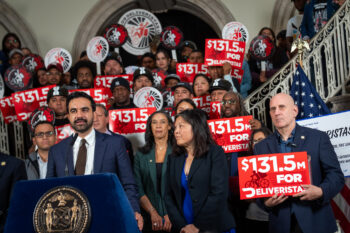
Mayor Mamdani & others celebrate DoorDash settlement (photo: Ed Reed/Mayor’s Office)
By Mark Chiusano
One of the persistent challenges of the gig economy is how difficult it can be to regulate and standardize pay.
Work performed through Uber, Lyft, DoorDash, and other gig apps is a crucial part of income for thousands of New Yorkers. For many, the gigs are full-time. Yet the pay can be extremely low – a 2022 report, for example, found that New York City food delivery workers made around $14 an hour, about half of which came from tips. This was the impetus for a minimum pay law for the food delivery sector that came into effect in 2023. It mandated $17.96 an hour before tips, a rate that increases with inflation and now stands at $22.13.
This has been a boon for many workers and a big victory for organizers and progressive legislators, who were trying to carve out some wage protections for independent contractors in the powerful and growing app field. Unfortunately, the law turned out to be merely the first stab at that goal – something made clear by the landmark $131.5 million settlement DoorDash recently agreed to with New York City for violating the pay law and underpaying or stiffing workers.
It’s merely the latest – and biggest – time that New York City has had to step in to shield delivery workers from financial exploitation. It was thus since the beginning. When the pay law debuted, Uber and DoorDash changed their app designs in New York, forcing consumers to leave tips only after checkout. If the goal was to make the cost of orders cheaper in the face of the new law, it worked, insofar as average gratuity plummeted from $3-$4 per order to $1.12 in the last quarter of 2025. The City Council ended up passing a new law to make the tip option more prominent again. That went into effect this year.
In the era of the new pay law, the app companies also pushed workers to accept shifts of just a few hours, making it much harder to simply log on and work – the original gig premise. The minimum pay was helpful, but many workers were not able to get enough hours to earn a real living. The end result is that more than 60% of New York City food delivery workers land below the federal poverty line, according to a brutal new survey.
But most chaotic and confusing might be a central tenet of the minimum pay law itself, one that the app companies have used to peculiar advantage: the requirement that workers get paid not only while they are actively delivering an order, but also while they are on-duty for the app and waiting for a task. Those minutes, known as “on-call” time, generate the same amount of money as delivery time. The money goes into an aggregate pool for the company to disburse to its deliverers, though not necessarily to the actual deliverer who was sitting there on the clock. In other words, the company is allowed to decide which deliverers get the bucks.
The way DoorDash does it, the on-call money goes to higher-rated and top-performing workers. In this way, it has become a management mechanism. Workers, who are not employees and don’t get standard workplace benefits or protections, nevertheless contort themselves to make every delivery the app suggests, working every late-night or early-morning hour and in every far-flung place that the app wants, so they might get a sniff at the on-call cash. The company disingenuously calls this money a “bonus,” not exactly the word I’d use to describe a legally mandated sum.
This feature of the law was presumably meant to prevent delivery workers from gaming the system – even though the app already limits log-ins to cut down on wasted time. But in practice it made the apps a murky black box, so workers have often struggled to tell when or if they are owed money for on-call time.
Indeed, workers were right to worry, as we now know thanks to the city’s enforcement action. The Department of Consumer and Worker Protection (DCWP) estimates that approximately $70 million of the total worker relief from the DoorDash settlement is attributable to violations of the law’s “aggregate” requirement, a DCWP spokesperson told me.
DoorDash has claimed that they simply “calculated on-call time differently than the City, and believe our approach was fair, practical, and legal.” Yet they decided to cede the issue, apologize, and prepare to make workers whole.
The eye-popping numbers are noteworthy, but more so is the city’s apparent commitment to closely monitor the apps, with a series of laws, including one to promote pay transparency, as well as a new research and analytics division at DCWP that can mine data for corporate violations. That kind of oversight is far beyond the ability of individual workers, who are at the mercy of faceless algorithms that obscure information or change quickly to suit the company’s whims.
The new data team housed at DCWP is supposed to get a lot more numbers from DoorDash thanks to this enforcement action, and they’ll likely be busy trying to keep up with whatever the apps do next. Expect more back and forth. That iterative process will likely have to be a feature, not a bug, of regulating the app-based gig economy.
***
Mark Chiusano is a journalist and Director of New York Law School’s Gig Economy Project. His book, “Dash, Drive, Deliver: A Year in America’s Gig Economy,” will be published by One Signal in August 2027.